
Mastering Your Footprint: The OSCRE Standard for Space Categorization.
The OSCRE framework replaces ambiguous internal naming with a rigorous, hierarchical code system. This universal language ensures every square foot is accounted for — enabling global benchmarking, operational efficiency and AI-ready data.
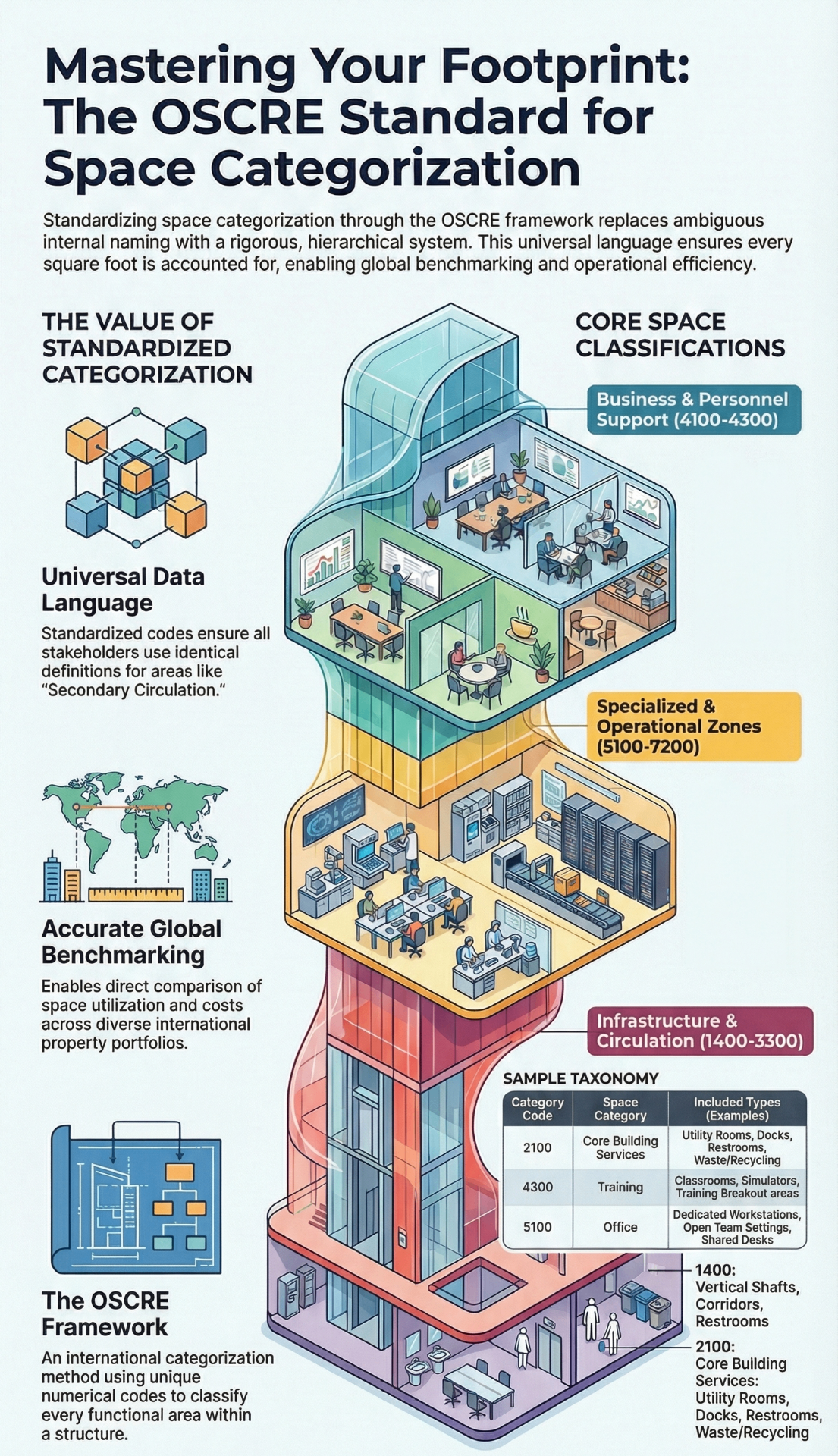
An international categorization method for every functional area.
OSCRE (the Open Standards Consortium for Real Estate) publishes data standards used by landlords, occupiers, service providers and technology platforms across the real estate industry. Its space categorization standard assigns a unique numerical code to every functional area in a structure.
The result is a shared vocabulary. Two organisations measuring the same kind of space — even in different countries, languages and accounting systems — describe it the same way. That single design choice unlocks benchmarking, AI reasoning and clean data interchange between systems that previously couldn't talk to each other.
Three families, one hierarchy.
OSCRE groups every functional area into one of three numeric ranges. Codes within each range describe progressively more specific space categories.
Infrastructure & Circulation
Vertical shafts, corridors, restrooms, core building services, utility rooms, docks and waste/recycling. The structural backbone every square foot depends on.
Business & Personnel Support
Offices, meeting rooms, collaboration zones, training rooms, classrooms and simulators — the space where work and learning actually happen.
Specialized & Operational Zones
Dedicated workstations, open team settings, shared desks, labs, data centres, manufacturing floors and other purpose-built operational space.
How OSCRE codes map to real space types.
A non-exhaustive view of the categories you'll work with most often.
| Category code | Space category | Included types (examples) |
|---|---|---|
| 1400 | Vertical Circulation | Vertical shafts, stairwells, elevator cores |
| 2100 | Core Building Services | Utility rooms, docks, restrooms, waste/recycling |
| 3300 | Horizontal Circulation | Primary corridors, secondary circulation |
| 4100 | Office Support | Mail rooms, copy/print, storage |
| 4300 | Training | Classrooms, simulators, training breakout areas |
| 5100 | Office | Dedicated workstations, open team settings, shared desks |
| 7200 | Specialized Operations | Labs, data centres, secure operations rooms |
Why this matters for modern FM teams.
Universal data language
Standardized codes ensure every stakeholder — landlord, tenant, FM team, auditor, AI agent — uses identical definitions for ambiguous areas like 'Secondary Circulation'.
Accurate global benchmarking
Compare space utilization, density and cost per category across diverse international property portfolios without translating between bespoke internal taxonomies.
AI-ready joins
OSCRE codes act as a stable join key between spaces, occupancy logs, work orders and energy data — so agents reason against real categories, not free-text labels.
From space record to AI-ready dimension.
Every space in IDN resolves through the portfolio spine — region → country → city → property → building → floor → space → subspace — and joins to an OSCRE category lookup. Status and occupancy changes are written to per-entity audit logs, so the OSCRE code is preserved alongside every reading.
- Lookup-backed category, not free text — no drift over time.
- Audit history captures reclassifications with timestamps.
- Reporting horizons (daily → yearly) pre-aggregate by OSCRE code.
- Agents query categories as first-class dimensions in the semantic layer.
OSCRE, answered.
Bring OSCRE to your portfolio.
Tell us about your space data today — legacy spreadsheets, mixed CAFM tools, or no taxonomy at all. We'll show how IDN maps your portfolio to OSCRE codes and turns it into AI-ready dimensions, usually in under two weeks.
- Free 30-minute portfolio review.
- Sample OSCRE mapping for one of your buildings.
- No CAFM contract required to start.
Categorize every square foot — once.
IDN ships with OSCRE as the default space taxonomy, plus the audit history and semantic layer that turn categories into AI-ready dimensions.